
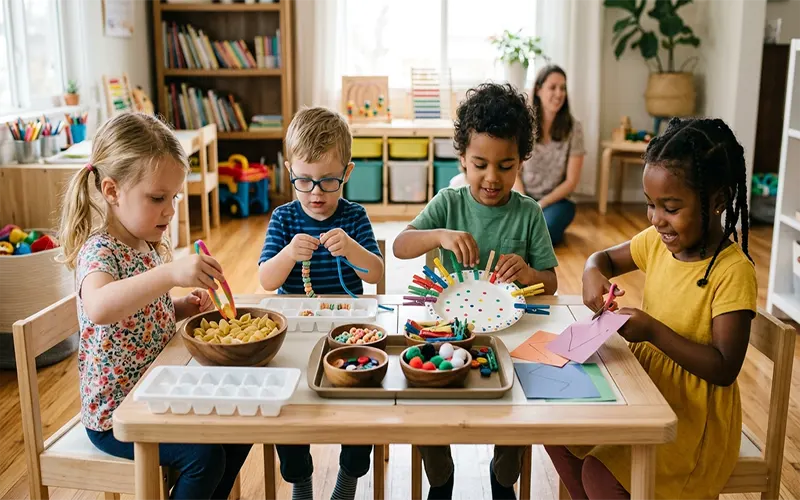
Developing fine motor skills—the coordination of small muscle movements in the hands, wrists, and fingers—is a foundational milestone for preschoolers. These skills are the invisible architects of future success, essential for everything from buttoning a shirt and using a spoon to eventually gripping a pencil for writing.
The best news for busy parents? You don’t need expensive educational kits or specialized sensory toys to support this development. Your own home is a goldmine of tools that can turn an ordinary afternoon into a powerhouse of skill-building play. By engaging in these simple activities, your child isn’t just “playing”; they are building the neural pathways and muscle strength necessary for lifelong independence.
Why Fine Motor Play Matters
At ages 3 to 5, children are transitioning from using their whole hand to grasp objects to using precise, refined movements. Key developmental goals include:
- Pincer Grasp: Using the thumb and index finger to pick up small items.
- Hand-Eye Coordination: Synchronizing visual input with hand movement.
- Bilateral Coordination: Using both hands together to perform a task (e.g., holding a paper with one hand while cutting with the other).
- Finger Isolation: Learning to move fingers independently of one another.
When you offer these activities, you are fostering focus, patience, and confidence. Here are some of the most effective, household-based ways to sharpen these critical skills.
8 Essential Household Fine Motor Activities
1. The Colander Threading Challenge
Items: A kitchen colander (upside down) and a handful of pipe cleaners or dry spaghetti noodles.
Instructions: Flip the colander over so the rounded bottom faces up. Have your child thread the pipe cleaners or noodles through the holes.
Developmental Bonus: This is the gold standard for hand-eye coordination and precision.
2. Clothespin Color Matching
Items: A cardboard cereal box and a variety of colored clothespins.
Instructions: Use markers to draw colored circles or lines around the edge of the cereal box. Have your child clip the matching color clothespin to that section.
Developmental Bonus: This builds significant finger strength and pincer grasp as the child exerts the pressure needed to open the pins.
3. Kitchen Tongs “Rescue” Mission
Items: A muffin tin, kitchen tongs, and small household items (pom-poms, cotton balls, or balled-up socks).
Instructions: Place one item in each muffin cup. Challenge your child to use the tongs to pick up each item and move it to a different cup or a bowl.
Developmental Bonus: Tongs provide excellent resistance training for the small muscles in the palm and fingers.
4. Tape Pulling & Peeling
Items: Masking tape or painter’s tape, and a baking sheet.
Instructions: Tear off several strips of tape and stick them haphazardly to a baking sheet. Encourage your child to “rescue” the tray by peeling off every single strip.
Developmental Bonus: This is fantastic for fingertip dexterity and building the “scratching” motion needed for future pen control.
5. Pasta Necklace Engineering
Items: A piece of yarn or shoelace and dry pasta (rigatoni or penne are easiest).
Instructions: Secure one end of the string with a large piece of pasta or a knot. Have your child string the pasta onto the lace to create a masterpiece.
Developmental Bonus: A classic for a reason—it reinforces sustained focus and two-handed coordination.
6. The “Sponge Squeeze” Race
Items: Two bowls (one filled with water) and two new, clean sponges.
Instructions: Have your child soak a sponge in the water, move it to the empty bowl, and squeeze all the water out. Repeat until the first bowl is dry.
Developmental Bonus: This is a surprisingly intense workout for hand and forearm muscles, while also providing soothing sensory input.
7. Button and Coin Drop
Items: An empty, cleaned plastic container (like a yogurt or coffee tub) and a handful of large buttons or coins.
Instructions: Cut a thin slit in the plastic lid of the container. Show your child how to insert the coins or buttons through the slot one by one.
Developmental Bonus: This requires precise spatial orientation and helps children learn to adjust an object’s angle to fit through a space.
8. Sticker “Connect the Dots”
Items: A sheet of paper and a roll of mailing labels or office stickers.
Instructions: Draw dots on a piece of paper and ask your child to place a sticker directly on each dot.
Developmental Bonus: Peeling stickers off a backing is an incredible exercise for the pincer grasp, requiring deep concentration and refined motor control.
A Note on Safety
Because these activities involve small household objects, always provide direct supervision. If you have younger siblings in the house, ensure the “small parts” are kept strictly out of reach. These activities are designed for active participation, not as “leave them alone” tasks!
Learning Through Connection
The beauty of these activities is that they aren’t meant to be “lessons” in the traditional sense; they are invitations to play. By setting up a quick station at the kitchen table while you are doing dishes or folding laundry, you are providing the perfect environment for your child to learn.
Don’t worry if your child doesn’t complete the task perfectly on the first try. The goal isn’t the finished necklace or the empty bowl of water—it’s the effort, the trial and error, and the focused time you spend together. Happy playing!