
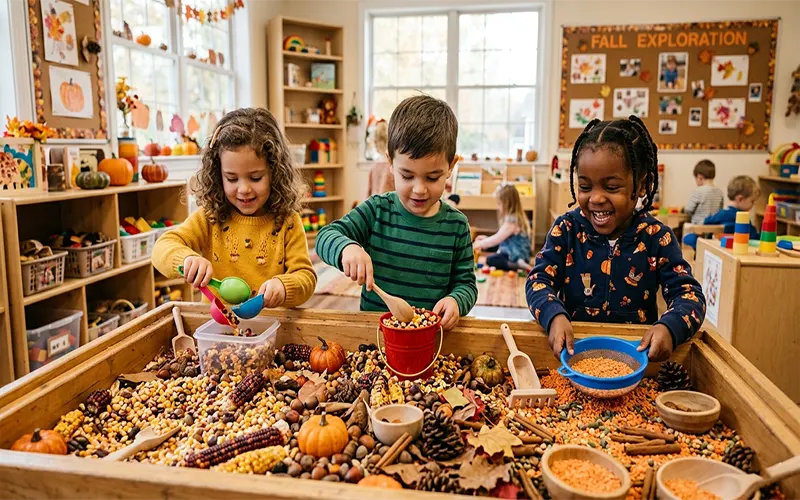
Autumn is perhaps the most sensory-rich season of the year. From the crunch of dry leaves underfoot to the smooth, cool skin of a pumpkin and the fragrant scent of cinnamon, fall provides a natural, vibrant backdrop for early childhood learning. For educators and parents, sensory bins are the perfect vehicle to bring this seasonal magic into the classroom or home.
When you incorporate sensory bins into your fall curriculum, you are doing far more than just providing “busy work.” You are facilitating critical development in fine motor control, building a sophisticated seasonal vocabulary, and fostering early mathematical skills like sorting, counting, and measurement.
The Science of Fall Sensory Play
Sensory bins offer a “low-stakes” environment where preschoolers can explore the properties of materials through touch, sight, and sound. Developmentally, these bins serve three primary pillars of early learning:
- Sensory Integration: Children learn to regulate their responses to different textures—the smooth, the rough, the cold, and the gritty.
- Mathematical Foundation: Bins naturally encourage sorting (by color or size), measuring volume (full vs. empty), and counting (number of items found).
- Language & Pre-Literacy: This is the perfect time to build “descriptive vocabulary.” Instead of just saying “leaf,” encourage the child to use words like serrated, brittle, vibrant, veins, or waxy.
8 Essential Fall Sensory Bin Themes
1. The Apple Orchard
- Base: Dried red lentils.
- Themed Objects: Small red and green pom-poms, wooden apple cutouts, a mini basket, and plastic tweezers.
- Learning Objective: Sorting and Categorization. Have students sort the “apples” by color or size using the tweezers to build pincer grasp.
2. The Great Pumpkin Patch
- Base: Dried corn kernels.
- Themed Objects: Mini gourds, silk autumn leaves, small plastic scoops, and clear containers.
- Learning Objective: Volume and Measurement. Use the scoops to fill the containers, introducing terms like heavy, light, full, and half-full.
3. Crunchy Nature Walk
- Base: Dried pinecones, acorns, and seed pods (sanitize first).
- Themed Objects: Magnifying glasses, small plastic woodland animals, and natural twigs.
- Learning Objective: Scientific Inquiry. Use the magnifying glasses to examine the textures of the acorns and pinecones, encouraging the use of comparative adjectives.
4. Spooky Spider Web
- Base: Black beans.
- Themed Objects: Plastic spiders, white yarn “webs,” and small tongs.
- Learning Objective: Fine Motor Refinement. Challenge the children to “rescue” the spiders from the yarn webs using only the tongs.
5. Harvest Wheat Field
- Base: Dried wheat berries or oat groats.
- Themed Objects: Miniature scarecrows, plastic farm animals, and small metal funnels.
- Learning Objective: Spatial Awareness. Using funnels helps children understand gravity and the flow of dry materials, a classic exercise in spatial logic.
6. Autumn Colors & Shapes
- Base: Dyed rice (orange, yellow, and brown).
- Themed Objects: Foam leaf cutouts with shapes or letters written on them, small buckets.
- Learning Objective: Pre-Literacy and Patterning. Hide specific lettered or shaped leaves in the rice. When found, the child must name the letter/shape before placing it in the corresponding bucket.
7. Rainy Day Forest
- Base: Navy blue water (add a drop of non-toxic food coloring).
- Themed Objects: Plastic frogs, lily pads, waterproof autumn leaves, and pipettes.
- Learning Objective: Cause and Effect. Using pipettes to move “rain” onto the leaves helps children practice sustained focus and hand control.
8. Cinnamon & Spice Kitchen
- Base: Brown rice mixed with a dash of cinnamon or nutmeg.
- Themed Objects: Silicone muffin tins, wooden spoons, and mini pie pans.
- Learning Objective: Sensory Desensitization & Imagination. This bin engages the sense of smell and encourages dramatic play, allowing children to “bake” pretend autumn pies.
Teacher & Parent Implementation Tips
To get the most out of your sensory bins while keeping your sanity intact, keep these professional tips in mind:
- Contain the Mess: Place the bins on a large, shallow tray (like a boot tray) to catch spills. If working in a classroom, define the “bin zone” with a rug to keep the materials contained.
- Vocabulary-Rich Dialogue: Don’t just watch the children play; participate. Ask open-ended questions like, “What does the pinecone feel like compared to the smooth apple?” or “How many scoops does it take to fill the bucket?”
- Rotate Materials: To prevent boredom, rotate the contents every two weeks. If the children lose interest, add a “new” tool—a funnel, a different sized scoop, or a new set of tweezers—to reinvigorate their curiosity.
Sensory bins are the unsung heroes of a robust fall curriculum. By providing a tactile experience that bridges the gap between structured lessons and free play, you offer preschoolers a holistic way to connect with the season. Whether your students are sorting lentils or “baking” with cinnamon, they are building the cognitive and physical muscles that will support them throughout their academic journey. Happy harvesting!