

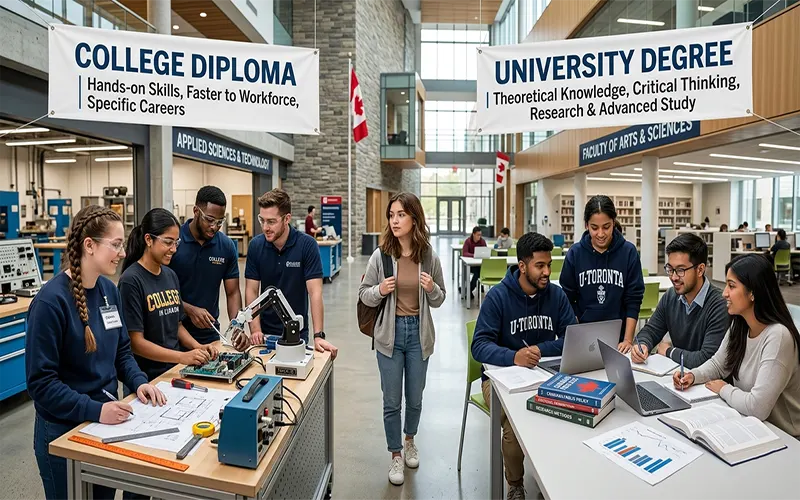
In Canada’s post-secondary landscape, the choice between a college diploma and a university degree is often misunderstood as a “ranking.” In reality, this is not a contest of better versus worse; it is a choice between two distinct educational philosophies: applied, vocation-specific learning versus broad, analytical, and theoretical exploration.
For students navigating their future, understanding this distinction is the key to aligning your education with your career aspirations, financial goals, and long-term immigration plans.
Defining the Credentials
The College Diploma: Applied Learning
College programs are designed to get you into the workforce. They are vocational, industry-aligned, and laser-focused on the technical skills required for a specific job.
- Duration: Typically 1 to 3 years.
- Focus: Practical, hands-on, and “job-ready.”
- Philosophy: “Learning by doing.”
The University Degree: Academic Breadth
University programs focus on the “why” as much as the “how.” They provide a comprehensive, research-based education that encourages critical thinking, leadership, and long-term analytical capacity.
- Duration: Typically 3 to 4 years.
- Focus: Theoretical, analytical, and foundational.
- Philosophy: “Learning to learn.”
The Decision Matrix: A Side-by-Side Comparison
| Feature | College Diploma | University Degree |
| Primary Goal | Fast entry into a specific trade or technical role. | Long-term career growth, management, & research. |
| Duration | 1–3 Years | 3–4 Years |
| Workplace Focus | Applied, technical, operational. | Analytical, leadership, strategic. |
| PGWP Eligibility | Restricted by CIP Codes (Labor shortages). | Exempt (No field-of-study restriction). |
| Career Path | Specialized, operational, technical. | Management, consulting, academic, leadership. |
Key Strategic Considerations
1. The Post-Graduation Work Permit (PGWP) Factor
For international students, the distinction between a diploma and a degree has become a critical strategic pivot point in 2026.
- Degree Programs: Bachelor’s, master’s, and doctoral degree graduates remain exempt from field-of-study restrictions for the PGWP. This provides the most stable path for post-graduation work.
- Non-Degree (Diploma) Programs: Eligibility is strictly tied to CIP Codes (Classification of Instructional Programs) that align with identified long-term labor shortages. Before enrolling in a diploma, you must verify that the program’s CIP code is on the current IRCC-approved list.
2. The “2+2” Pathway: The Best of Both Worlds
Many Canadian students leverage the stackable credential system. A popular strategy is the “2+2” model:
- Years 1–2: Complete a specialized college diploma to gain immediate, hireable technical skills.
- Years 3–4: Transfer those credits into a university bachelor’s degree program to gain the credentials required for management and senior-level roles.
This path is often more cost-effective and provides both a technical foundation and a management-ready degree.
3. Career Outcomes and Salary
Statistics Canada data shows that bachelor’s degree holders generally earn higher average annual incomes and have lower unemployment rates over the long term compared to diploma-only graduates. However, college graduates often experience a faster “time-to-market,” securing employment in technical fields (like trades, nursing, or IT support) within months of graduation.
Strategic Success Checklist
Before you commit to an application, ask yourself these four questions:
- What is my five-year goal? If you aspire to lead teams, manage budgets, or influence strategy, a degree is often the prerequisite. If you want to master a technical craft and start working as quickly as possible, a diploma is ideal.
- What is my target industry? Research job postings in your field. Do they ask for a “degree” or a “diploma”? Some industries (like engineering management or healthcare administration) are degree-heavy, while others (like graphic design or culinary arts) value the portfolio or technical training provided by a diploma.
- Have I verified PGWP eligibility? If you are an international student, have you cross-referenced your program’s CIP code with the current IRCC eligibility list?
- Am I open to the “2+2” path? If you are unsure, investigate whether your target college program has an articulation agreement with a local university. This keeps your options open.
In the Canadian context, your choice between a college diploma and a university degree is not a final verdict on your career success—it is simply the first step. Because Canada’s education system is highly modular, you are never locked into one path. Whether you choose the rapid, technical focus of a diploma or the comprehensive, leadership-oriented foundation of a degree, you are engaging in a system that values lifelong learning and the strategic “stacking” of credentials. Choose the path that best fits your current goals, and remember: you can always build upon your foundation tomorrow.