

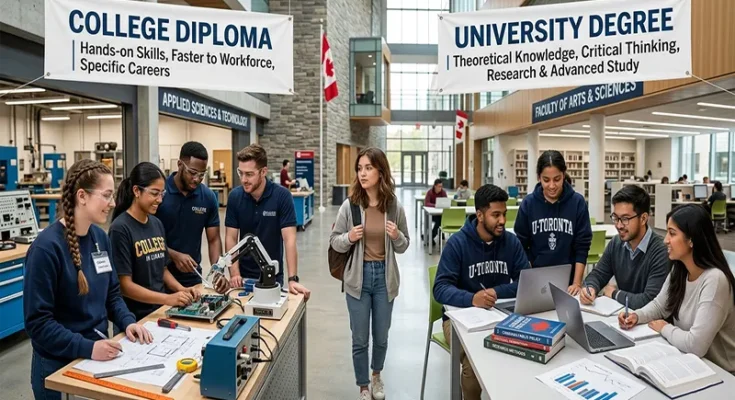
College Diploma vs. University Degree in Canada: Which Path is Right for You?

College Diploma vs. University Degree in Canada: Which Path is Right for You?

In Canada’s post-secondary landscape, the choice between a college diploma and a university degree is often misunderstood as a “ranking.” In reality, this is not a contest of better versus worse; it is a choice between two distinct educational philosophies: applied, vocation-specific learning versus broad, analytical, and theoretical exploration.

For students navigating their future, understanding this distinction is the key to aligning your education with your career aspirations, financial goals, and long-term immigration plans.

Defining the Credentials

The College Diploma: Applied Learning

College programs are designed to get you into the workforce. They are vocational, industry-aligned, and laser-focused on the technical skills required for a specific job.

  • Duration: Typically 1 to 3 years.
  • Focus: Practical, hands-on, and “job-ready.”
  • Philosophy: “Learning by doing.”

The University Degree: Academic Breadth

University programs focus on the “why” as much as the “how.” They provide a comprehensive, research-based education that encourages critical thinking, leadership, and …

College Diploma vs. University Degree in Canada: Which Path is Right for You? Read More


Fast-Track Online Bachelor Degree Completion Programs in the USA

Fast-Track Online Bachelor Degree Completion Programs in the USA

In the professional landscape of 2026, millions of Americans find themselves in the “some college, no degree” category. Whether you stepped away for work, family, or financial reasons, the good news is that the higher education system has evolved to meet you exactly where you are. Degree completion programs are no longer just “catch-up” courses; they are highly efficient, strategic pathways designed to get you across the finish line as quickly as possible.

If you have already earned college credits, you are sitting on a valuable asset. The goal now is to maximize that asset by choosing an institution that prioritizes Prior Learning Assessment and accelerated delivery models.

How “Fast-Track” Actually Works

Not all online programs are designed for speed. To graduate quickly, you must look for institutions that utilize specific mechanisms to bypass redundant coursework:

  • Competency-Based Education (CBE): In a traditional model, you pay for time (16-week semesters).
Fast-Track Online Bachelor Degree Completion Programs in the USA Read More
Hands-On Alphabet Matching Preschool Activities for Beginners

Hands-On Alphabet Matching Preschool Activities for Beginners

For many parents, the pressure to “prepare” a child for school often translates into a stack of boring worksheets and rote flashcard drills. However, if you talk to any early childhood development expert, they will tell you the same thing: preschoolers do not learn through passive observation; they learn through their hands, their senses, and their whole bodies.

Alphabet matching is a fundamental developmental milestone. It is the bridge between seeing a squiggle on a page and understanding that the shape holds a specific sound and identity. By turning this process into a hands-on, playful experience, you transform a chore into a core memory, building confidence rather than frustration.

The Developmental “Why”

Why do we choose matching over memorization? Because matching engages visual discrimination—the ability to notice the subtle differences between shapes (like the difference between a ‘b’ and a ‘d’).

When a child physically manipulates a letter, they …

Hands-On Alphabet Matching Preschool Activities for Beginners Read More
How Feedback Loops Drive Skill Mastery in Remote Programs: Is SDI Worth It for Hands-On Training Online

How Feedback Loops Drive Skill Mastery in Remote Programs: Is SDI Worth It for Hands-On Training Online

Is the Sonoran Desert Institute worth it? For students learning technical skills online, the answer often lies in how well feedback is built into the educational process. The Sonoran Desert Institute (SDI), accredited by the Distance Education Accrediting Commission (DEAC), has developed a structured feedback system that replicates the hands-on guidance students typically receive in an in-person training environment. Weekly tasks, detailed instructor comments, and iterative improvement provide students with the support they need to reach professional standards from the comfort of their own homes.

In traditional trade environments, instructors stand beside students, correcting techniques in real time. Remote programs must recreate this level of mentorship through digital means. It achieves this by breaking each course into predictable weekly cycles, using mailed projects, digital submissions and time-stamped instructor feedback. The result is a consistent rhythm that drives skill development in a step-by-step manner.

Weekly Structure Builds Consistency

Each week …

How Feedback Loops Drive Skill Mastery in Remote Programs: Is SDI Worth It for Hands-On Training Online Read More
Best Post-Secondary Institutions in Canada with Leading Co-op Programs

Best Post-Secondary Institutions in Canada with Leading Co-op Programs

In the competitive landscape of the 2026 labor market, a degree alone is often not enough. Employers are increasingly seeking graduates who arrive with proven professional experience and industry-ready skills. This is where Cooperative Education (Co-op) stands apart.

Unlike a standard internship—which is often a single, isolated placement—a Co-op program is a structured, academic strategy that alternates between semesters of classroom study and full-time, paid work terms. By the time you graduate, you aren’t just a student; you are a professional with a resume, a network, and a deep understanding of your industry.

Why Co-op Matters in 2026

Participating in a Co-op program provides a distinct “work-ready” advantage:

  • Bridge to Employment: Statistics consistently show that Co-op graduates have higher employment rates and higher starting salaries than their non-Co-op counterparts.
  • Financial Autonomy: In many fields like Computer Science or Engineering, Co-op earnings can significantly offset tuition and living costs, helping students
Best Post-Secondary Institutions in Canada with Leading Co-op Programs Read More