

College Diploma vs. University Degree in Canada: Which Path is Right for You?

College Diploma vs. University Degree in Canada: Which Path is Right for You?

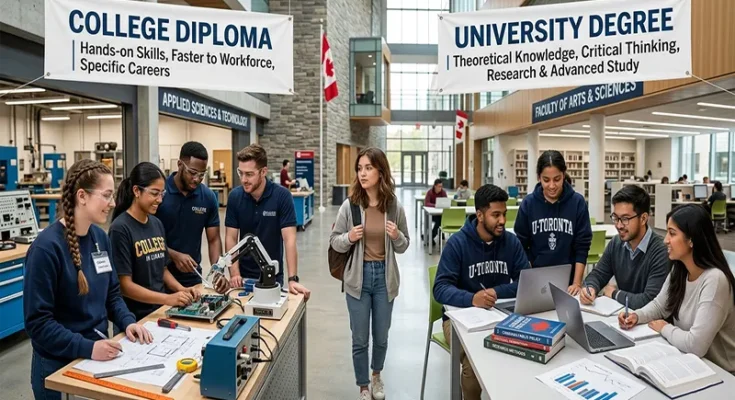
In Canada’s post-secondary landscape, the choice between a college diploma and a university degree is often misunderstood as a “ranking.” In reality, this is not a contest of better versus worse; it is a choice between two distinct educational philosophies: applied, vocation-specific learning versus broad, analytical, and theoretical exploration.

For students navigating their future, understanding this distinction is the key to aligning your education with your career aspirations, financial goals, and long-term immigration plans.

Defining the Credentials

The College Diploma: Applied Learning

College programs are designed to get you into the workforce. They are vocational, industry-aligned, and laser-focused on the technical skills required for a specific job.

  • Duration: Typically 1 to 3 years.
  • Focus: Practical, hands-on, and “job-ready.”
  • Philosophy: “Learning by doing.”

The University Degree: Academic Breadth

University programs focus on the “why” as much as the “how.” They provide a comprehensive, research-based education that encourages critical thinking, leadership, and …

College Diploma vs. University Degree in Canada: Which Path is Right for You? Read More
Best Post-Secondary Institutions in Canada with Leading Co-op Programs

Best Post-Secondary Institutions in Canada with Leading Co-op Programs

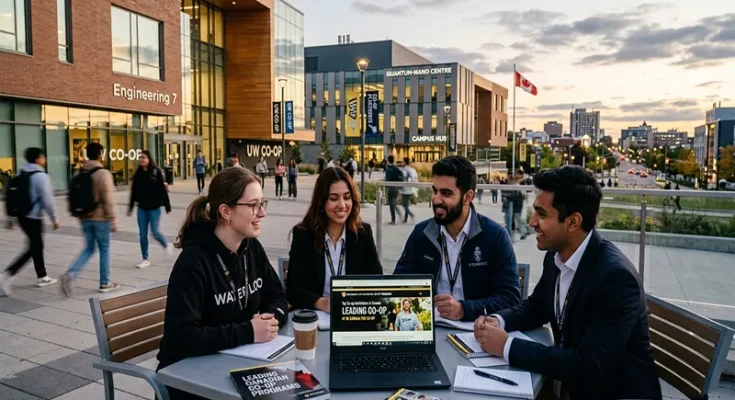
In the competitive landscape of the 2026 labor market, a degree alone is often not enough. Employers are increasingly seeking graduates who arrive with proven professional experience and industry-ready skills. This is where Cooperative Education (Co-op) stands apart.

Unlike a standard internship—which is often a single, isolated placement—a Co-op program is a structured, academic strategy that alternates between semesters of classroom study and full-time, paid work terms. By the time you graduate, you aren’t just a student; you are a professional with a resume, a network, and a deep understanding of your industry.

Why Co-op Matters in 2026

Participating in a Co-op program provides a distinct “work-ready” advantage:

  • Bridge to Employment: Statistics consistently show that Co-op graduates have higher employment rates and higher starting salaries than their non-Co-op counterparts.
  • Financial Autonomy: In many fields like Computer Science or Engineering, Co-op earnings can significantly offset tuition and living costs, helping students
Best Post-Secondary Institutions in Canada with Leading Co-op Programs Read More
Guide to Eligible PGWP Post-Secondary Programs in Canada for 2026

Guide to Eligible PGWP Post-Secondary Programs in Canada for 2026

For international students, the Post-Graduation Work Permit (PGWP) has long been the primary bridge between Canadian education and permanent residency. However, as of 2026, the era of “automatic” work permits is over. Canada has implemented a stricter, more strategic framework that ties your ability to work after graduation directly to Canada’s current labor market needs.

If you are currently studying or planning to enroll, simply graduating from a Designated Learning Institution (DLI) is no longer a guarantee of eligibility. You must now navigate a system defined by field-of-study restrictions, language thresholds, and specific program requirements.

The Two-Tier Eligibility System

The Canadian government now differentiates between university degree programs and non-degree programs when determining PGWP eligibility.

1. Degree Programs (Bachelor’s, Master’s, PhD)

If you are pursuing a university degree, you remain in the most favorable position. These programs are exempt from field-of-study restrictions. Whether you study Humanities, Business, or STEM, …

Guide to Eligible PGWP Post-Secondary Programs in Canada for 2026 Read More
Affordable Post-Secondary Options for Career Advancement

Affordable Post-Secondary Options for Career Advancement

In today’s competitive job market, continuous learning and career advancement are crucial for success. However, many individuals may hesitate to pursue further education due to the high cost of post-secondary programs. Fortunately, there are affordable options available that can still provide valuable skills and qualifications for career growth. Let’s explore some of these affordable post-secondary options for individuals seeking career advancement:

1. Community Colleges:

Community colleges offer a wide range of programs at a more affordable price compared to traditional four-year institutions. These colleges provide an excellent opportunity to gain practical skills and knowledge in various fields, such as healthcare, technology, trades, and business. Many community colleges also have partnerships with local industries, which can enhance job prospects and provide practical, hands-on experience.

2. Online Learning Platforms:

Online learning platforms have gained popularity in recent years and are a cost-effective way to acquire new skills and qualifications. Platforms like Coursera, …

Affordable Post-Secondary Options for Career Advancement Read More
Exploring Post-Secondary Options for Non-Traditional Learners: A Path to Success

Exploring Post-Secondary Options for Non-Traditional Learners: A Path to Success

Choosing the right post-secondary education path is a critical decision that can significantly impact an individual’s future. While the traditional college experience might be the go-to choice for many, non-traditional learners often have different needs, circumstances, and priorities to consider. In this article, we will delve into the various post-secondary options available for non-traditional learners and explore how these alternatives can lead to a successful and fulfilling educational journey.

Understanding Non-Traditional Learners

Non-traditional learners are individuals who pursue higher education at a later stage or in a non-conventional manner. They may be working professionals seeking to enhance their skills, parents balancing family responsibilities, individuals looking for a career change, or those who couldn’t pursue a college degree earlier due to personal circumstances. Understanding the needs and aspirations of non-traditional learners is crucial in identifying the most suitable post-secondary options for them.

Flexible Online Programs

Online programs have emerged as an …

Exploring Post-Secondary Options for Non-Traditional Learners: A Path to Success Read More